

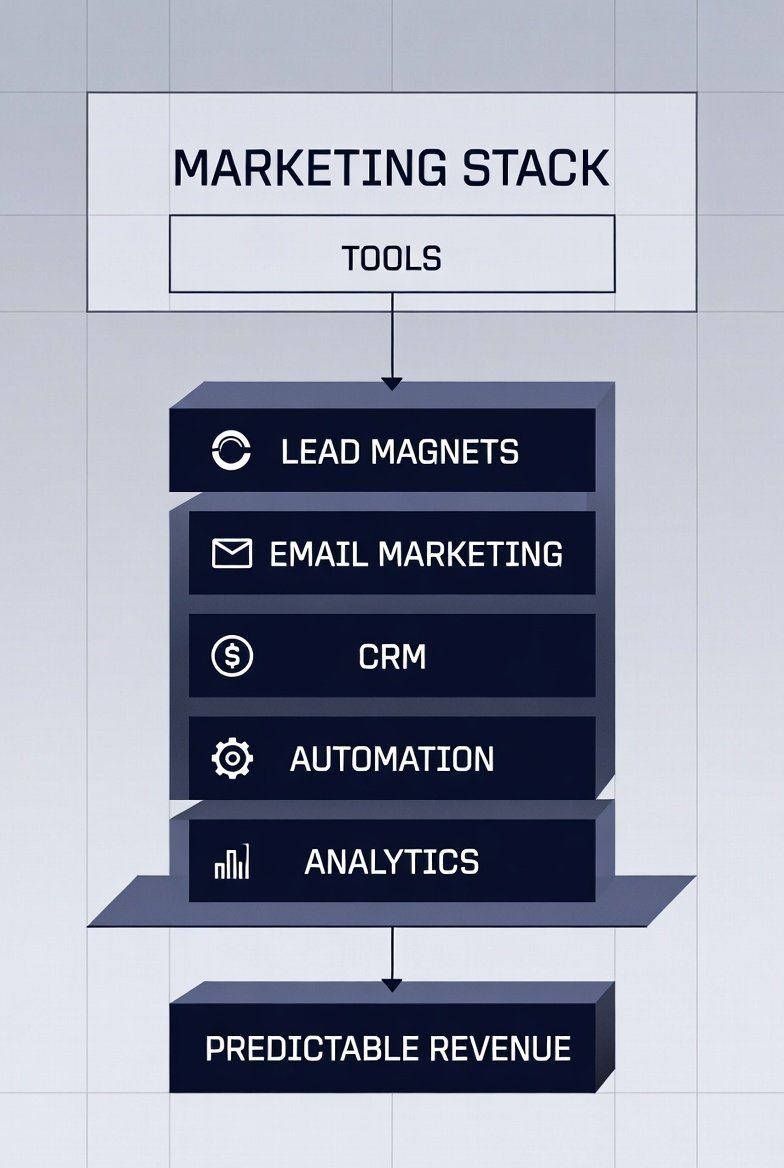
Marketing Stack
Most companies don’t struggle because they lack marketing tools.
They struggle because their tools don’t operate as a system.
New platforms get added.
Old tools never get retired.
Data fragments.
Attribution conflicts.
Dashboards disagree.
Eventually, leadership asks a dangerous question:
“Which number is actually correct?”
When no one can answer with confidence, the problem is not marketing execution.
It is infrastructure failure.
A marketing stack is not software inventory.
It is the engineered environment that determines whether marketing operations with clarity — or controlled chaos.
Organizations that design their stack deliberately gain operational leverage.
Those that accumulate tools slowly lose visibility.
And visibility is what executives fund.
What a Marketing Stack Actually Is
At the surface level, a marketing stack (or martech stack) is the collection of technologies used to plan, execute, measure, and optimize marketing activity.
But serious operators understand the deeper reality:
Your stack is the operating environment where revenue intelligence is created.
It defines:
- where customer truth lives
- how signals are captured
- how lifecycle movement is tracked
- how attribution is governed
- how forecasts are trusted
When the stack is structured properly, marketing becomes predictable.
When it is not, growth feels accidental.
The Revenue Stack Blueprint™
Elite organizations rarely build infrastructure without a mental model.
The Revenue Stack Blueprint™ is a six-layer architecture that transforms scattered tools into a coordinated revenue system.
1. System of Record — The Anchor of Truth
Every stack needs a gravitational center.
For most organizations, this is the CRM setup.
It preserves:
- accounts
- contacts
- pipeline stages
- revenue outcomes
If multiple systems compete for “truth,” reporting collapses into debate.
Rule: One system owns revenue reality.
Everything else feeds it.
2. System of Engagement — Where Buyer Interaction Happens
This layer captures and influences behavior.
Typically includes:
- marketing automation
- email platforms
- ad platforms
- SMS / lifecycle messaging
- personalization engines
Engagement tools generate signals — but should never define truth.
They inform the system of record.
3. Orchestration Layer — Turning Motion Into Flow
Tools alone do not create execution.
Marketing Workflow does.
The orchestration layer connects systems so that actions trigger downstream movement automatically.
Examples:
- form submission → CRM record
- lead score threshold → routing
- opportunity stage change → lifecycle campaign
- closed deal → attribution update
Without orchestration, teams operate manually.
Manual motion does not scale.
4. Intelligence Layer — Where Decisions Are Formed
Executives do not read raw dashboards.
They rely on structured intelligence.
This layer typically includes:
- governed reporting
- BI environments
- attribution models
- forecasting views
Here is the contrarian truth:
Most stacks fail not because they lack tools — but because leadership cannot extract decisions from the data those tools produce.
Intelligence is the purpose of infrastructure.
5. Identity & Consent Layer — The Silent Risk Controller
As privacy expectations rise, identity management becomes foundational.
This includes:
- consent management
- preference centers
- identity resolution
- regulatory compliance controls
Ignoring this layer creates hidden operational risk that surfaces later — often expensively.
Infrastructure must anticipate regulation.
Not react to it.
6. Experience Layer — Where the Market Meets the System
This is the outward-facing environment:
- website / CMS
- landing pages
- product surfaces
- conversational tools
It is where engagement begins — but it should be deeply connected to the layers beneath it.
Disconnected experiences generate unusable data.
Connected experiences generate intelligence.
Where the Marketing Stack Lives in the Revenue Ecosystem
Your stack does not exist in isolation.
It reinforces the architecture you are already building:
Marketing Operations → defines structure
Workflow → governs execution
Automation → accelerates motion
CRM → anchors truth Marketing
Reporting → enables decisions
Stack → connects everything
Remove the stack, and the ecosystem fractures.
Infrastructure is interdependent by nature.

The Executive Consequence of Poor Stack Design
Stack failures rarely announce themselves dramatically.
Instead, they appear gradually:
- attribution disputes
- pipeline inconsistencies
- duplicated contacts
- forecasting volatility
- reporting distrust
Soon, finance builds independent models.
Sales questions marketing data.
Leadership slows investment.
None of this is a tooling problem.
It is an architectural one.
Minimal Stack vs. Scale Stack — Designing for Your Stage
Not every organization needs enterprise complexity.
The smartest teams design for current reality with future flexibility.
Minimal Viable Stack (Early Growth)
- CRM
- marketing automation
- website/CMS
- analytics
- basic reporting
The objective is clarity — not sophistication.
Complexity too early is operational debt.
Integrated Growth Stack
As volume rises, integration becomes mandatory.
Add:
- attribution tooling
- enrichment
- advanced workflow automation
- governed dashboards
The goal shifts from execution to predictability.
Enterprise Stack
At scale, governance becomes the priority.
Expect:
- warehouse or centralized data layer
- strict permission structures
- compliance tooling
- advanced forecasting
- lifecycle orchestration
Here, infrastructure stops supporting growth.
It enables strategy.
The Tool Sprawl Problem (And How Elite Teams Prevent It)
Unchecked stacks expand rapidly.
New tools promise efficiency — but often introduce fragmentation.
Prevent this with five operator rules:
1. Enforce a System Owner
Every tool must have accountable ownership.
2. Protect the System of Record
Never allow shadow databases.
3. Eliminate Functional Overlap
Redundancy creates conflicting signals.
4. Run Quarterly Stack Audits
Retire tools aggressively.
5. Govern Data Definitions
Metrics must mean the same thing everywhere.
Discipline is what keeps infrastructure coherent.
Integration — The Circulatory System of Your Stack
Think of integration as blood flow.
When it is blocked, the organism weakens.
A healthy data path typically follows:
Capture → Enrich → Score → Route → Convert → Attribute → Forecast
Break that chain anywhere, and decision quality drops.
Integration is not a technical luxury.
It is an executive requirement.
The Point of No Return
There is a stage in organizational growth when spreadsheets stop holding.
Manual exports multiply.
Teams reconcile numbers late into the night.
Forecast meetings stretch endlessly.
At that moment:
Once leadership cannot trace how revenue data moves across systems, infrastructure stops being optional — it becomes existential.
Companies that redesign early scale smoothly.
Those that delay often rebuild under pressure.
Rebuilding is always more expensive.
Implementation Roadmap — A 90-Day Infrastructure Reset
Stack transformation does not require multi-year programs.
Momentum matters more than perfection.
Days 1–30 — Audit
- inventory tools
- identify overlaps
- map data flows
- locate truth sources
Clarity begins with visibility.
Days 31–60 — Architect
- define system of record
- establish integration priorities
- standardize lifecycle stages
- align metric definitions
Structure prevents future entropy.
Days 61–90 — Govern
- assign ownership
- document rules
- establish dashboard standards
- enforce change protocols
Infrastructure survives through governance.
Always.
The Future — Stacks Are Becoming Intelligent
The next evolution is already underway.
Expect stacks to increasingly leverage:
- AI-assisted orchestration
- predictive lifecycle modeling
- automated anomaly detection
- unified customer graphs
- real-time revenue intelligence
Soon, stacks will not merely support marketing.
They will guide leadership decisions proactively.
Organizations preparing now will adapt fastest.
Balanced Perspective — The Complexity Tax
Even strong stacks carry tradeoffs.
Risks include:
- vendor lock-in
- escalating costs
- operational complexity
- adoption friction
The answer is disciplined minimalism.
Capture what strengthens decisions.
Remove what does not.
Clarity scales better than abundance.
Contrarian Insight Worth Remembering
A larger stack does not create sophistication.
A coherent stack does.
Some of the highest-performing marketing organizations operate with fewer tools than their competitors — because their architecture is intentional.
Infrastructure is not about accumulation.
It is about alignment.
Bottom Line
A marketing stack is the connective infrastructure that determines whether data becomes intelligence — and whether intelligence becomes confident investment.
When engineered deliberately, governed consistently, and integrated intelligently, the stack stops being a collection of tools.
It becomes the environment where predictable growth is constructed.
Organizations that master this capability do more than execute campaigns efficiently.
They build the operational clarity that leadership trusts enough to scale.
FAQs
What is a marketing stack?
A marketing stack is the structured collection of technologies that capture signals, manage customer data, orchestrate engagement, and generate intelligence for strategic decisions.
Why is a marketing stack important?
Because leadership relies on integrated data to forecast revenue, allocate budgets, and scale confidently.
What is the most important layer in a stack?
The system of record — typically the CRM — because it anchors revenue truth.
When should companies upgrade their stack?
When attribution becomes unreliable, reporting conflicts emerge, or manual processes begin slowing decision velocity.
What is the biggest mistake in stack design?
Accumulating tools without architectural intent or governance.