
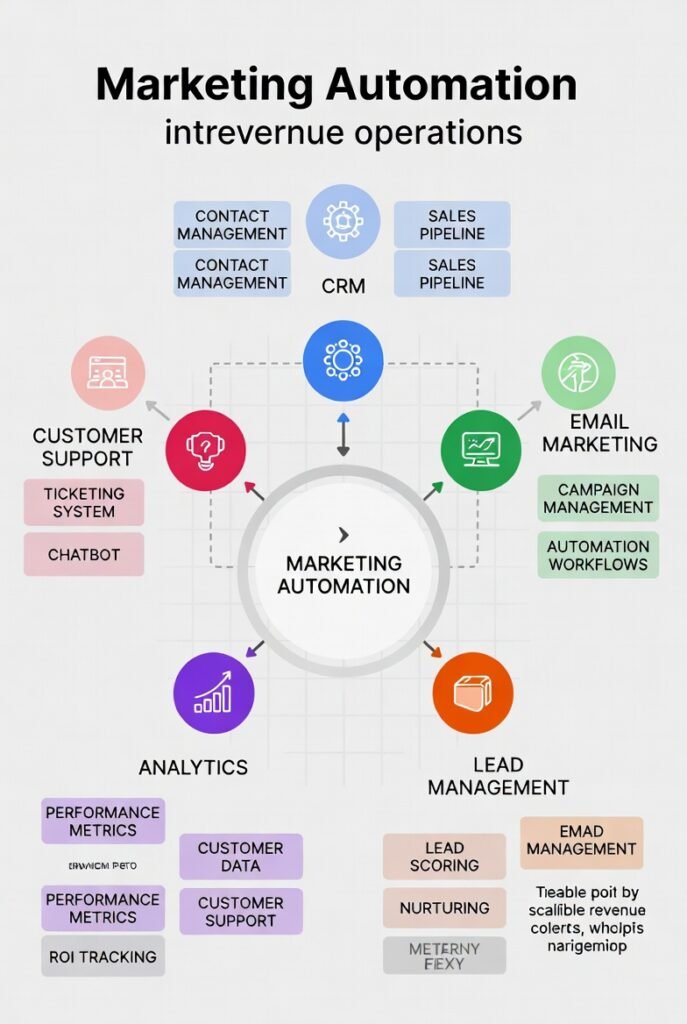
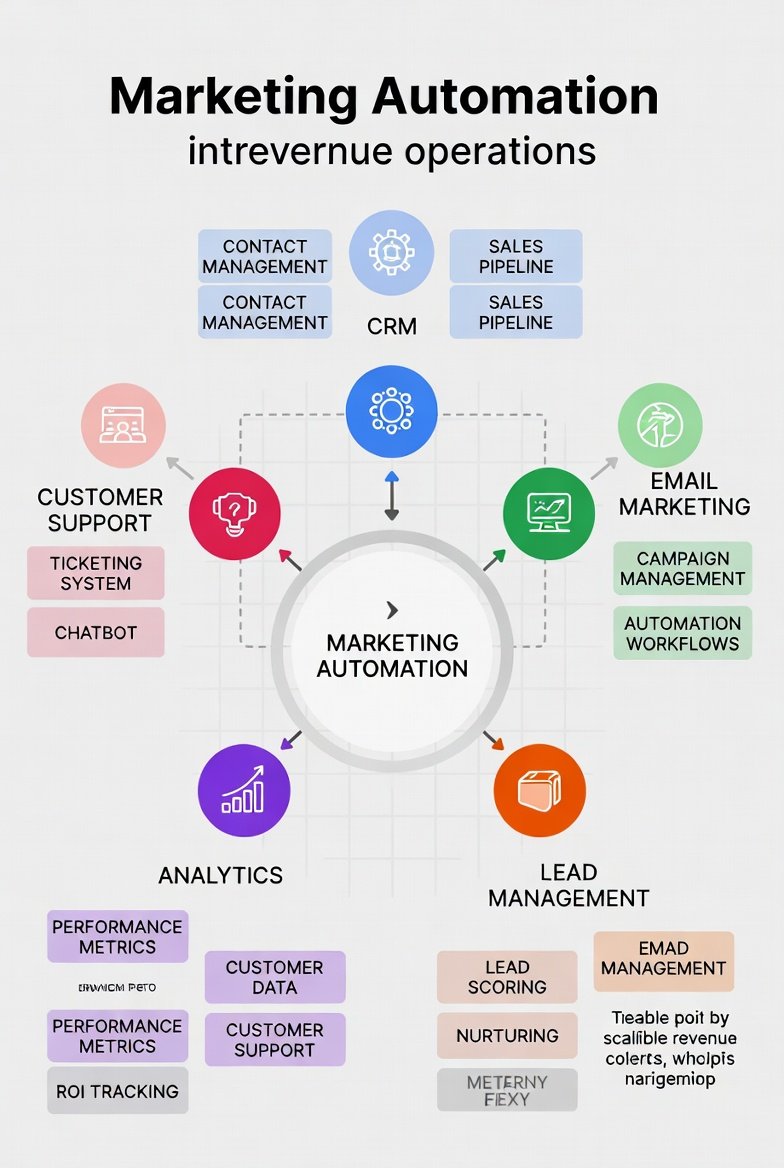
Marketing Automation Integrations
Marketing automation rarely fails because the platform is weak.
It fails because the ecosystem around it is fractured.
Disconnected CRMs.
Isolated product data.
Ad platforms that don’t reconcile.
Lifecycle signals trapped in silos.
What appears to be an automation issue is almost always an integration architecture failure.
Serious operators eventually realize something critical:
Marketing automation is not the center of the system.
The integration layer is.
This guide is written for Marketing Ops leaders, RevOps architects, demand generation owners, and integration-conscious executives responsible for building infrastructure that scales without corrupting data or distorting measurement.
This is not a tutorial.
It is an architectural briefing.
Integration Architecture Framework™
Before evaluating connectors or middleware, understand the structural flows you are designing.
High-performing organizations align integrations across four operational currents:
Flow | Operational Purpose | Risk if Broken |
Data Flow | Maintain unified records | Fragmented customer view |
Signal Flow | Trigger automation reliably | Journey disruption |
Attribution Flow | Preserve measurement accuracy | Reporting distrust |
Lifecycle Flow | Orchestrate stage movement | Revenue leakage |
Most integration mistakes occur when teams focus on connections instead of flows.
Connections are technical.
Flows are operational.
Operators design flows.
Contrarian Insight — Automation Problems Are Rarely Automation Problems
Most automation breakdowns are blamed on platforms.
In reality, the root cause is almost always integration design.
Poor schema discipline.
Conflicting field ownership.
Unclear systems of record.
Automation simply exposes architectural weaknesses faster.
When integrations stabilize, automation suddenly appears “smarter” — even though the tool never changed.
The Hidden Economics of Integration Failure
Integration errors rarely announce themselves dramatically.
They surface quietly:
attribution drift
duplicate contacts
misrouted leads
delayed signals
forecasting distortion
The financial impact compounds invisibly.
A lifecycle delay of even a few hours can degrade conversion velocity.
Misattributed pipeline can redirect budget incorrectly.
Duplicate records inflate performance assumptions.
Integration is not a technical concern.
It is a revenue-protection function.
Failure Signals That Indicate Architectural Strain
Operators usually begin reevaluating integrations when they observe:
reporting discrepancies across platforms
lifecycle inconsistencies
manual data reconciliation
automation behaving unpredictably
pipeline attribution debates
These are not workflow inconveniences.
They are indicators of systemic fragility.
The Point of No Return — Integration Edition
You’ve crossed it when:
leadership questions reporting integrity
RevOps begins auditing lifecycle movement
forecasting confidence weakens
manual workarounds multiply
At this stage, integrations stop being technical enhancements.
They become operational infrastructure.
Delaying architectural correction rarely reduces complexity — it compounds it.
Integration Maturity Model™
Integration success correlates strongly with organizational evolution.
Stage | Integration Reality | Operational Risk |
Early | Manual exports | Data inconsistency |
Growing | Point-to-point sync | Automation fragility |
Scaling | Middleware adoption | Governance pressure |
Advanced | Orchestrated ecosystem | Change-management risk |
Maturity mismatch is one of the most common causes of integration regret.
Advanced tooling cannot compensate for immature governance.
The Real Battleground — Data Authority
Every integrated environment must answer one foundational question:
Where does truth live?
Without a defined system of record, platforms begin competing for authority:
CRM vs automation platform
product database vs billing system
ad platforms vs analytics
When truth is ambiguous, reporting becomes negotiable.
And once metrics become negotiable, executive trust erodes quickly.
Most companies don’t lose operational clarity because tools are weak —
they lose it because data authority was never defined.

Integration Failure Patterns™
Experienced operators recognize these immediately.
Failure Pattern | Root Cause | Operational Impact |
Sync conflicts | Competing field ownership | Data corruption |
Duplicate records | Weak identity rules | Inflated pipeline |
Latency | Poor event handling | Lifecycle delays |
Automation loops | Circular triggers | Workflow chaos |
Schema drift | Uncontrolled field creation | Reporting breakdown |
Integrations rarely fail loudly.
They fail structurally.
The SERP Reality Most Teams Discover Late
Adding integrations does not create alignment.
Architecture does.
Many organizations accumulate connectors rapidly:
CRM → automation → ads → analytics → product → support.
Yet no governing model exists.
The result is operational noise — not intelligence.
Design the system first.
Connect second.
Governance third.
Governance Layer™ — Where Serious Operators Separate Themselves
Governance is not bureaucracy.
It is scalability insurance.
Prioritize five disciplines:
- Schema Discipline
Define fields deliberately. Prevent uncontrolled sprawl. - Field Ownership
Every critical data point needs a single authority. - System of Record
Ambiguity is the fastest path to reporting distrust. Review your CRM setup to reinforce clarity at the foundation. - Permission Architecture
Control who can modify structural data. - Change Management
Every integration adjustment should follow review protocols.
Once governance exists, integrations stop behaving unpredictably.
Stack Compression Principle™
Mature organizations trend toward fewer — but stronger — integrations.
Each additional connector introduces:
latency risk
schema complexity
troubleshooting overhead
Integration sprawl is operational debt.
A tighter marketing stack improves ecosystem cohesion and is easier to govern — and far easier to trust.
Fast Disqualification Matrix™
Reduce architectural risk early.
If Your Organization Needs… | Avoid… |
High data integrity | Ad-hoc native connectors |
Lifecycle precision | Manual sync workflows |
Attribution confidence | Batch-only integrations |
Rapid scalability | Tool-level patching |
Elimination is often the highest-leverage architectural decision.
Integration Architecture Models
Understanding structural approaches prevents reactive design.
Native Integrations — Controlled Simplicity
Best For: Early-stage ecosystems.
Strength: Low friction.
Risk: Limited flexibility as complexity grows.
Not Ideal For: Multi-system lifecycle orchestration.
Operator Insight: Native works — until it doesn’t.
Middleware Platforms — Scalable Coordination
Best For: Scaling organizations managing multiple systems.
Strength: Centralized logic and transformation.
Risk: Governance requirements increase.
Not Ideal For: Teams lacking operational ownership.
Operator Insight: Middleware introduces leverage — but demands discipline.
iPaaS / Orchestration — Strategic Infrastructure
Best For: Advanced RevOps environments.
Strength: Event-driven automation and deep customization.
Risk: Change management becomes critical.
Not Ideal For: Immature schema environments.
Operator Insight: Orchestration transforms integrations into a strategic capability.
When Integrations Become a Leadership Concern
Integration architecture quickly enters executive territory when it influences:
pipeline forecasting
revenue attribution
expansion modeling
board-level reporting
If your marketing reporting framework cannot reconcile lifecycle movement with revenue signals, the constraint is not campaign performance — it is infrastructure.
Serious organizations treat integration stability as a planning input.
Not a technical detail.
Cost Reality — The Three Invisible Taxes
Integration rarely appears expensive upfront.
Costs compound through:
Complexity Tax
More systems require more oversight.
Latency Tax
Delayed signals degrade responsiveness.
Governance Tax
Someone must own the architecture — continuously.
Evaluate operational burden, not subscription price.
Migration Risk Snapshot™
Risk | Failure Mode | Mitigation Strategy |
Data loss | Historical gaps | Archive before transition |
Workflow disruption | Team confusion | Stage deployments |
Reporting resets | Executive hesitation | Preserve baselines |
Connector failure | Automation breakage | Monitor aggressively |
Integration changes should be treated as infrastructure projects — not quick optimizations.
Adoption Friction Forecast™
Expect resistance around:
field standardization
process enforcement
ownership clarity
reporting reinterpretation
Infrastructure introduces accountability.
That accountability is precisely what enables scale.
30-60-90 Integration Stabilization Pattern
30: Audit flows. Identify authority systems.
60: Enforce schema discipline. Align connectors. Strengthen lead tracking to preserve identity integrity.
90: Establish governance cadence. Align lifecycle orchestration within your marketing workflow.
Stability always precedes scalability.
Balanced Drawbacks
More integration increases structural responsibility.
Greater data visibility raises executive expectations.
Architectural maturity demands operational rigor.
But serious organizations rarely regret system clarity.
Final Operator Guidance
Do not ask:
“Which integrations should we add?”
Ask:
“Which architecture preserves data authority as we scale?”
Because once leadership trusts the system…
Decision velocity accelerates.
Design the integration environment you can govern confidently for the next 24–36 months.
That is the real investment.
FAQs
Why are marketing automation integrations strategically important?
They unify data, stabilize lifecycle orchestration, and protect reporting integrity.
What is the biggest integration mistake organizations make?
Connecting tools without defining data authority.
When should middleware be considered?
When point-to-point integrations begin creating operational fragility.
Do integrations affect revenue forecasting?
Yes — distorted data leads directly to distorted projections.
Is governance necessary for mid-sized companies?
Absolutely. Governance becomes critical well before enterprise scale.
Should integrations be centralized?
Whenever possible — centralized architecture reduces schema conflict.
What predicts long-term integration success?
Clear ownership, disciplined schema, and defined systems of record.