
Document Version Control Systems: The Operational Safeguard Most Organizations Assume They Already Have
Most organizations believe they are working from the latest document.
Until they aren’t.
A contract is approved using an outdated clause.
A policy revision never reaches the right team.
A pricing sheet circulates after it was replaced.
The mistake rarely comes from negligence.
It comes from version ambiguity.
And version ambiguity scales faster than most operational risks because it hides inside everyday workflows.
This is not a beginner file-management guide — it is an operational control framework designed for organizations that treat documentation as decision infrastructure.
Because when documentation fails, execution follows.
What a Document Version Control System Really Does
At a surface level, version control tracks document changes over time.
But mature organizations understand something far more important:
Version control is not about file history.
It is about decision defensibility.
A controlled document environment allows leadership to answer — immediately and confidently:
- Which version is authoritative?
- Who approved it?
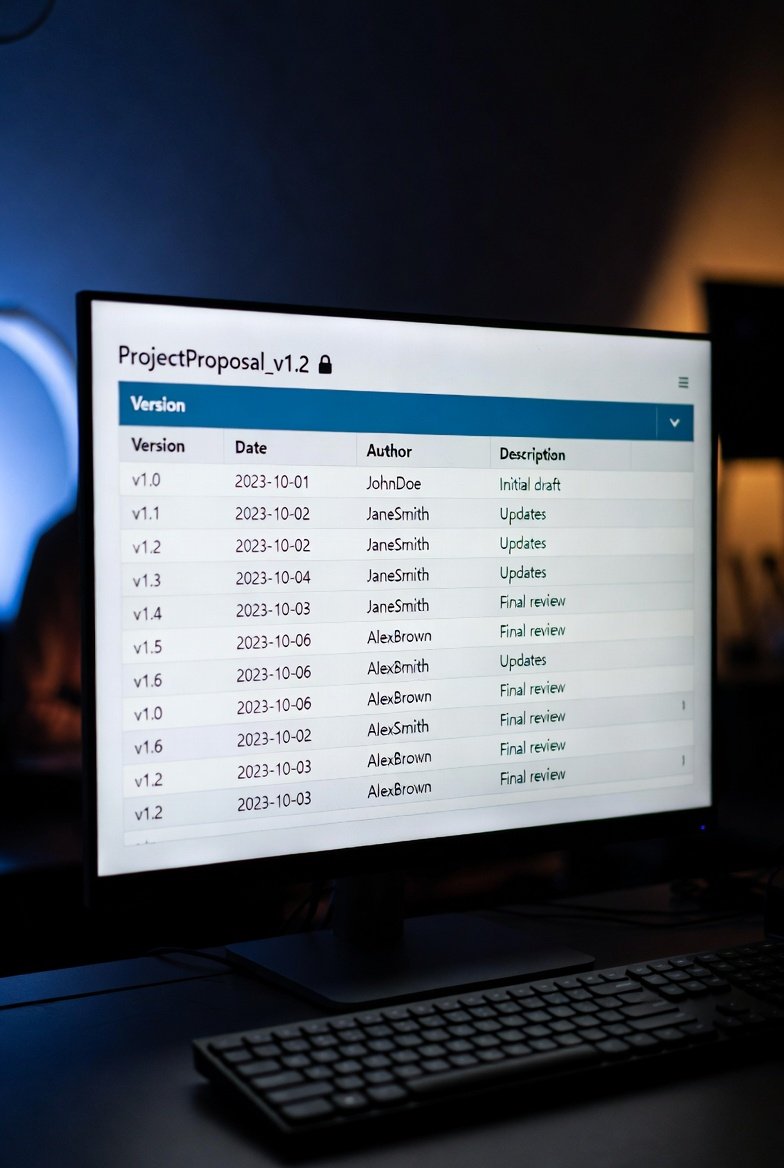
- What changed?
- When did it change?
- Why was it changed?
Without this clarity, documentation becomes informational rather than authoritative.
And authoritative documents are what scalable organizations operate on.
Many companies strengthen version discipline alongside structured approval workflows, ensuring validated documents — not assumptions — guide execution.
Control compounds reliability.
The Silent Risk of Version Chaos
Version problems rarely announce themselves dramatically.
Instead, they surface quietly:
- duplicate files across departments
- conflicting edits
- unauthorized revisions
- inconsistent naming
- parallel “final” versions
Individually inconvenient.
Collectively dangerous.
Version Control vs Version Chaos — A Quick Diagnostic
If any of these sound familiar, risk is already accumulating:
- Teams regularly ask, “Is this the latest version?”
- Files stored on personal devices
- Approval detached from the document
- No audit trail exists
- Ownership is unclear
Version chaos is rarely noticed — until it becomes expensive.
Infrastructure removes that uncertainty.
A Failure Scenario That Quietly Cost Millions
A global manufacturer once approved an outdated supplier contract containing pre-negotiation pricing.
The discrepancy went unnoticed for an entire quarter.
By the time finance identified the issue, the organization had locked itself into rates nearly 18% above the negotiated structure.
The failure wasn’t legal.
It wasn’t financial oversight.
It was version confusion.
Strong version governance prevents these events quietly — ensuring outdated documents cannot impersonate authority.
Infrastructure protects margin.
The Document Control Maturity Curve
Version governance typically evolves as operational complexity increases.
Stage | Document Reality | Organizational Exposure |
Shared Drives | Files scattered | Severe |
Naming Discipline | Manual control | Fragile |
Tracked Versions | Revision visibility | Improving |
Controlled Documents | Permission-based edits | Stable |
Auditable Systems | Full traceability | Executive confidence |
Most organizations linger dangerously between stages two and three — relying on human discipline where systemic control is required.
Maturity begins when governance stops depending on memory.
Version Control vs Document Management — Know the Boundary
These terms often blur together, yet they solve different problems.
Capability | Version Control | Document Management |
Tracks revisions | ✔ | ✔ |
Maintains history | ✔ | ✔ |
Governs authority | ✔ | Partial |
Prevents overwrite risk | ✔ | Varies |
Enables audit defense | ✔ | Often limited |
Document management organizes information.
Version control protects its integrity.
Also important:
👉 Version control is not collaboration — it is controlled documentation.
Collaboration accelerates creation.
Control protects decisions.
Enterprises require both.
Why Version Governance Directly Reinforces Organizational Authority
Documents shape operational reality:
- contracts
- compliance procedures
- pricing frameworks
- brand standards
- internal policies
When version discipline aligns with broader content governance, leadership gains confidence that execution reflects authorized intent.
Authority is not declared.
It is traceable.
Traceability scales trust.
Core Capabilities That Define Enterprise-Grade Version Control
Rather than chasing feature overload, focus on structural safeguards.
Automated Version Tracking
Captures every change without relying on human discipline — removing memory from the control chain.
Permission Architecture
Defines exactly who can edit, approve, publish, or archive — preventing silent authority drift.
Immutable Audit History
Creates defensible documentation during regulatory review or legal scrutiny.
If challenged, the organization can demonstrate control instantly.
Check-In / Check-Out Protocol
Prevents simultaneous edits that generate conflicting realities.
A small safeguard with disproportionate stability impact.
Approval Alignment
Ensures new versions cannot replace controlled documents without structured validation, often reinforced through dedicated approval workflow software.
Execution follows authority — not convenience.
System Integration
Version control should integrate cleanly with CRM platforms, operational tools, and structured marketing reporting, ensuring decisions reflect verified documentation.
Systems should reinforce institutional memory — not fragment it.
Modern Expectations Shaping Version Control
Enterprise document environments are evolving rapidly.
Leading platforms increasingly provide:
- AI-powered search that surfaces authoritative files instantly
- intelligent metadata tagging for faster retrieval
- OCR that converts static records into searchable knowledge
- automated classification that reduces human error
- deep integrations with Microsoft 365 and collaboration ecosystems
These capabilities do more than improve efficiency.
They reduce retrieval friction while strengthening governance.
Modern version control is no longer passive storage — it is intelligent operational infrastructure.
Implementation Snapshot — What Successful Rollouts Actually Look Like
Version control rarely fails because of technology.
It fails because structure arrives too late.
A proven rollout sequence:
1️⃣ Define document owners
Authority must attach to every critical file.
2️⃣ Establish naming protocols
Consistency reduces search friction and misinterpretation.
3️⃣ Lock permission tiers
Editing is a privilege — not a default.
4️⃣ Activate automated version tracking
Removes reliance on human behavior.
5️⃣ Align approvals with version changes
Ensures authority travels with revisions.
Leadership involvement accelerates adoption dramatically.
Technology enables control — leadership legitimizes it.
When “Free” Tools Quietly Increase Organizational Risk
Basic platforms often include lightweight version tracking.
They may suffice when documentation risk is low.
But problems emerge when organizations rely heavily on:
- consumer-grade Google Drive deployments
- unmanaged Dropbox environments
- loosely governed shared folders
- entry-level SharePoint configurations
These setups create the appearance of control — without delivering defensible governance.
The apparent savings often disappear the moment audit readiness is tested.
Governance is rarely the place to optimize for minimal cost.
Failure Patterns Mature Organizations Learn to Eliminate
Version initiatives struggle when architecture is unclear.
Watch for these early warnings:
- duplicate repositories
- inconsistent permissions
- undocumented overrides
- uncontrolled offline copies
These failures rarely stem from software.
They stem from structural ambiguity.
Clarity scales.
Ambiguity compounds.
A Neutral Platform Landscape — Governance-Strong Systems
The platforms below illustrate environments known for structured version governance.
Selection should reflect compliance complexity — not market popularity.
Governance-Centric Enterprise Platforms
- M-Files — metadata-driven architecture ideal for controlled environments
- DocuWare — strong workflow + compliance capabilities
- OpenText — widely trusted in highly regulated enterprise ecosystems
- Laserfiche — respected for process-driven governance
- Alfresco (Hyland) — flexible and customizable for structured deployments
Cloud-Native / Hybrid Leaders
- Microsoft SharePoint + Purview — deep compliance integration across the Microsoft ecosystem
- Box — governance-grade security combined with modern collaboration
- Egnyte — strong hybrid control for distributed organizations
Platform selection should follow governance requirements — not brand familiarity.
The Strategic Economics of Version Control
Version control rarely appears on revenue dashboards.
Yet it protects revenue by:
- preventing contractual errors
- reducing compliance exposure
- avoiding operational rework
- stabilizing decision inputs
Predictability becomes a quiet competitive advantage.
Especially when competitors operate from fragmented documentation.
When Organizations Truly Need Version Control Infrastructure
Watch for these operational inflection points:
- documentation volume accelerates
- regulatory oversight increases
- authority disperses across departments
- audit expectations intensify
At this stage, version governance stops being administrative.
It becomes strategic infrastructure.
Organizations often reinforce these controls within the broader marketing stack, ensuring execution reflects current, validated information.
Alignment reduces friction.
Limitations Worth Recognizing
Version control introduces discipline — but excessive rigidity can slow collaboration.
Smaller organizations with low documentation risk may function effectively with lighter controls.
The objective is proportional governance.
Not procedural weight for its own sake.
Sophistication should match exposure.
Version Governance as a Signal of Organizational Maturity
Externally, controlled documentation signals reliability.
Internally, it creates confidence that teams operate from verified information.
Confidence accelerates execution.
Execution compounds growth.
Enterprises rarely regret formalizing document control.
They regret assuming it already existed.
Final Takeaway
A document version control system is not merely a storage upgrade.
It is the infrastructure through which organizations protect the integrity of the information guiding their decisions.
For companies approaching operational scale, version governance transforms documentation from shared knowledge into controlled authority.
For those not yet there, restraint remains wise.
Adopt version infrastructure when complexity demands it — and design it deliberately from the beginning.
Because organizations rarely stumble due to a lack of information.
They stumble when they act on the wrong version of it.
And disciplined version control quietly ensures they don’t.