
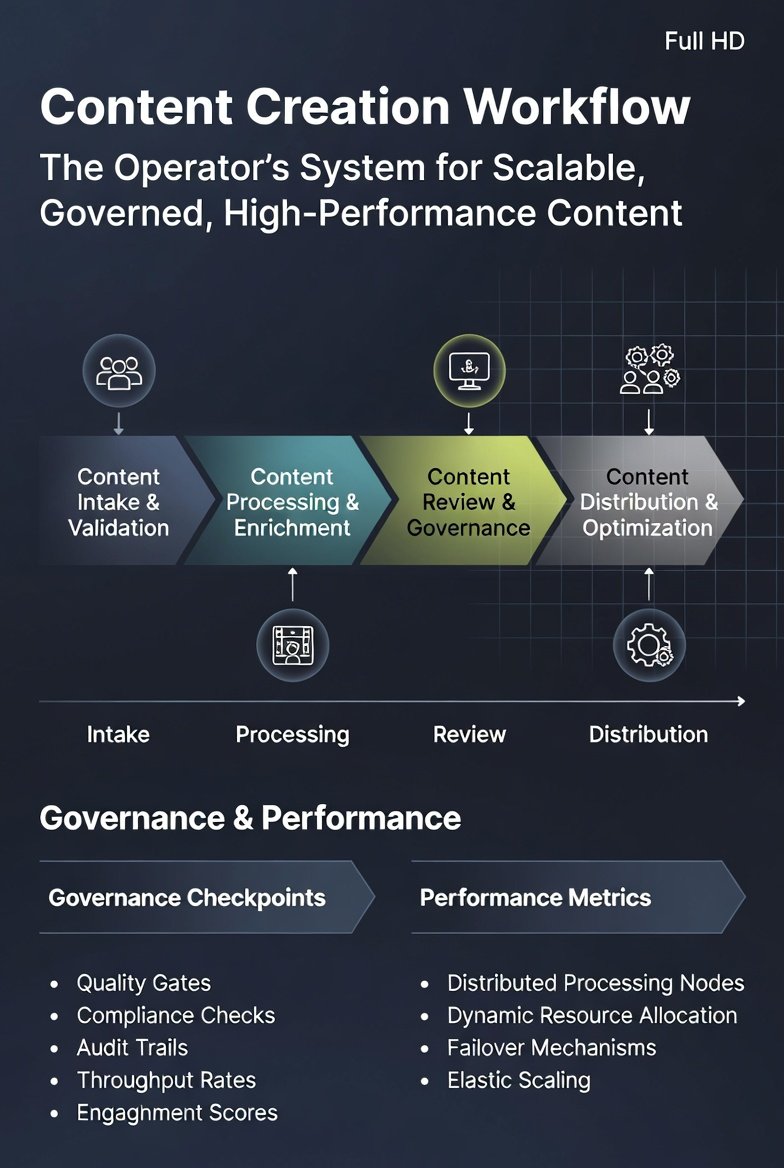
Content Creation Workflow
Content rarely fails because teams lack creativity.
It fails because production systems collapse under scale.
Deadlines slip.
Approvals bottleneck.
Messaging fragments.
Multiple versions circulate.
No one knows which asset is final.
What begins as a marketing initiative quietly becomes operational drag.
Here is the uncomfortable truth operators eventually learn:
Content is not a creative problem.
It is a workflow problem.
Elite organizations do not rely on talent alone.
They engineer production infrastructure.
A content creation workflow is that infrastructure.
It transforms content from unpredictable effort → into repeatable execution.
Executive Definition (Snippet Target)
A content creation workflow is a governed operational system that defines how ideas move from strategy to publication through structured roles, approval paths, automation layers, and performance feedback loops — ensuring scalable, consistent content output without organizational friction.
The leadership question is simple:
👉 Can your team double content output tomorrow without doubling chaos?
If not — you don’t have a workflow.
You have a habit.
The Hidden Cost of Workflow Failure (Executive Fear Trigger)
Poor workflow rarely looks catastrophic at first.
It looks like minor inefficiency.
Until scale exposes it.
Workflow Breakdown | Organizational Impact |
Approval delays | Missed market windows |
Version confusion | Brand inconsistency |
Undefined ownership | Execution stalls |
Reactive publishing | Strategy drift |
No performance loop | Wasted budget |
Tool sprawl | Operational friction |
Most teams try to fix this with more meetings.
Operators fix it with architecture.
Decision Velocity — Why Workflow Is a Leadership Lever
Content speed is not created by urgency.
It is created by decision clarity.
Weak systems create:
- endless revisions
- unclear authority
- approval paralysis
- reactive publishing
Elite systems create:
Weak Workflow | Operator Workflow |
Creative chaos | Structured flow |
Opinion-driven edits | Governed approvals |
Last-minute work | Predictable cadence |
Slow launches | Accelerated execution |
Workflow is not about control.
It is about protecting momentum.
⭐ Operator-Level Content Workflow Template (Primary Ranking Asset)
Use this as the backbone of your system.
Stage | Owner | Governance Rule |
Strategy | Marketing leadership | Define objectives first |
Ideation | Content strategist | Align to business goals |
Brief creation | Strategist / SEO | One source of truth |
Production | Creators | Follow documented standards |
Editorial review | Editor | Enforce quality + voice |
Compliance / brand | Governance team | Protect risk |
Approval | Decision owner | Single authority |
Publishing | Ops | Controlled release |
Distribution | Marketing | Channel-specific |
Performance loop | Analytics | Inform next cycle |
👉 Insert downloadable workflow template here.
project communication plan template
Most SERP pages stop at steps.
Operators define authority.
The Governance Stack Behind Elite Content Teams
High-output organizations operate across five structural layers:
1. Strategic Layer — Content Must Serve Direction
Content is not volume.
It is market positioning.
Every asset should answer:
👉 What business objective does this support?
If the answer is unclear — production is noise.
2. Role Architecture — Where Most Teams Fail
Ambiguity kills velocity.
Define ownership early.
Role | Responsibility |
Strategist | Direction |
SEO / research | Opportunity |
Creator | Execution |
Editor | Quality |
Legal / compliance | Risk |
Decision owner | Final approval |
The non-negotiable rule:
👉 Collaboration ends where accountability begins.
If everyone edits — no one owns.

Why Over-Collaboration Destroys Content Speed (Contrarian Insight)
Many organizations assume more feedback improves quality.
Often it produces paralysis.
stakeholder-collaboration causes:
- diluted voice
- revision loops
- slower launches
- creative fatigue
The objective is not universal agreement.
It is informed authority.
Strong teams listen widely — but approve narrowly.
The Single Source of Truth (Massive SERP Gap)
Content friction explodes when multiple realities exist.
Choose ONE hub:
- Notion
- Airtable
- Asana
- ClickUp
- Monday
Then enforce a rule:
👉 If it isn’t in the system — it isn’t happening.
This single discipline eliminates operational ambiguity overnight.
Effective stakeholder management
🔥 Approval Ladder (Elite Artifact)
Most workflows ignore escalation.
That is why publishing stalls.
Scenario | Authority | Response Window |
Minor edit | Editor | 24 hrs |
Strategic shift | Marketing lead | 48 hrs |
Brand risk | Governance | Immediate |
Legal exposure | Counsel | Same day |
Approval workflow clarity is velocity protection.
Not bureaucracy.
AI — The New Workflow Multiplier
AI is rapidly reshaping content operations.
Used correctly, it compresses production cycles through:
- assisted drafting
- outline generation
- metadata creation
- summarization
- performance insights
But operators understand:
👉 AI accelerates systems — it does not replace them.
Without content governance, AI scales inconsistency.
With governance, it scales excellence.
Cadence Engineering — Predictability Builds Throughput
Elite teams publish on rhythm — not panic.
Example cadence:
Content Type | Frequency |
Authority pieces | Monthly |
SEO assets | Weekly |
Thought leadership | Biweekly |
Updates | Ongoing |
Consistency signals reliability — internally and externally.
Performance Loop — The Step Most Workflows Ignore
Publishing is not the finish line.
It is the midpoint.
Measure:
Metric | Insight |
Time to publish | Workflow efficiency |
Revision count | Brief quality |
Organic lift | Strategic alignment |
Conversion impact | Business value |
Content decay | Refresh need |
What gets measured evolves.
What doesn’t becomes waste.
Content Workflow Maturity Model
Level | Organizational State |
Level 1 | Ad hoc creation |
Level 2 | Basic scheduling |
Level 3 | Structured workflow |
Level 4 | Governed system |
Level 5 | Predictive content engine |
Most companies plateau at Level 2.
Operators push toward Level 4+.
That is where scale becomes effortless.
The Point of No Return
There is a moment when informal production collapses.
Usually triggered by:
- rapid growth
- multi-channel expansion
- brand exposure
- regulatory scrutiny
At this stage…
Workflow is no longer optional.
It becomes operational infrastructure.
Potential Drawbacks (Balanced Perspective)
Strong workflows introduce:
- upfront planning
- defined approvals
- structured tooling
But unmanaged content chaos is exponentially more expensive than disciplined production.
The goal is not rigidity.
It is controlled creative velocity.
What Elite Content Operations Actually Look Like
Inside mature organizations:
- roles are obvious
- authority is visible
- approvals are predictable
- production scales smoothly
- performance informs strategy
This is not bureaucracy.
It is execution architecture.
Final Executive Takeaway
A content creation workflow is not a checklist.
It is a control system.
Without it:
- content slows
- quality drifts
- strategy fragments
With it:
- output scales
- messaging stabilizes
- leadership retains control
Clarity is engineered.
Not improvised.