
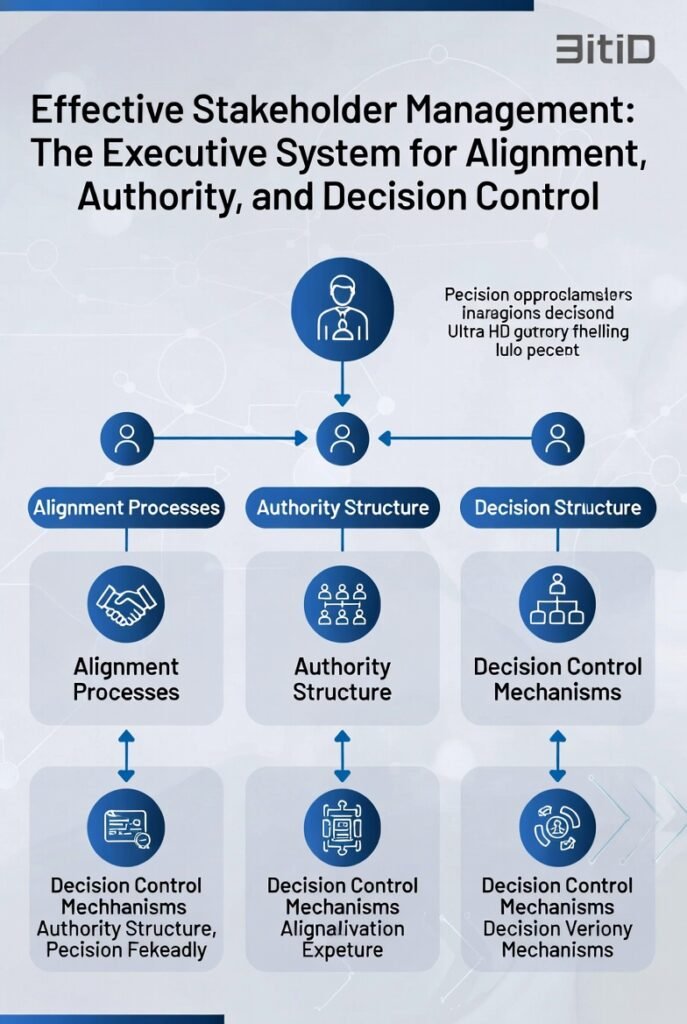
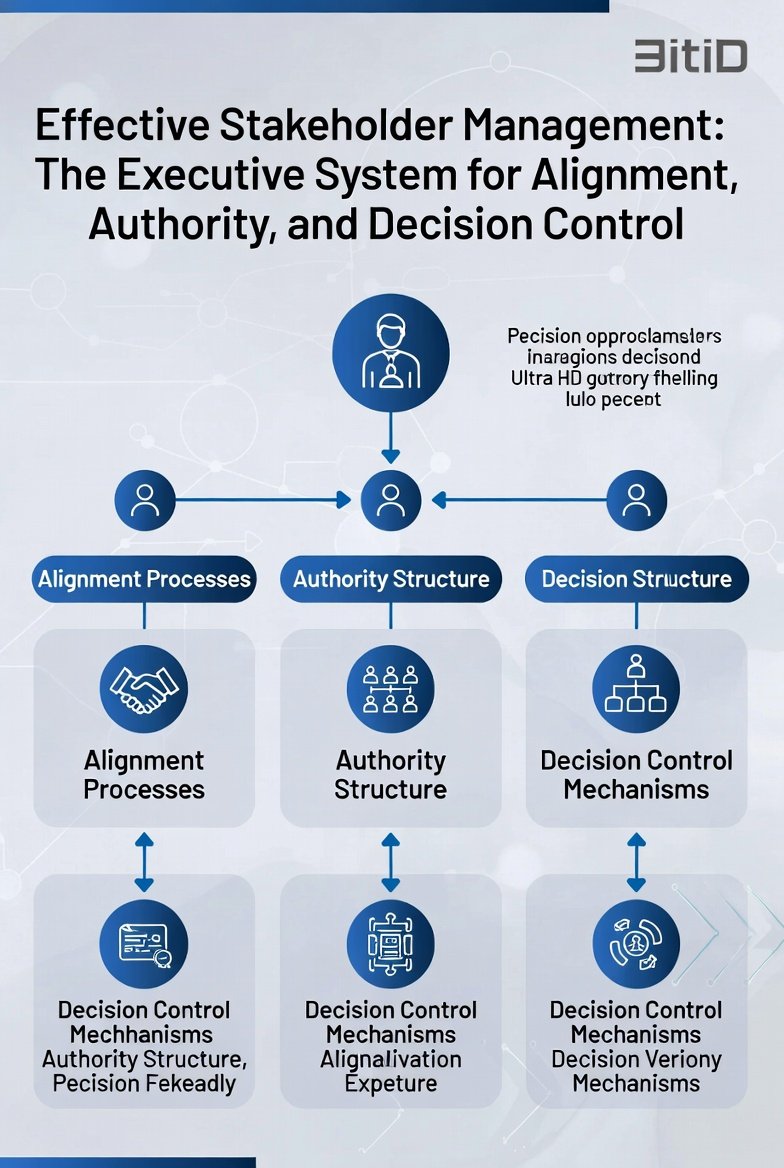
Effective Stakeholder Management
Organizations rarely fail because leaders lack intelligence.
They fail because stakeholder forces were underestimated until resistance became unavoidable.
A strategy is approved.
Budgets are allocated.
Execution begins.
Then friction appears.
Legal raises concerns.
Operations push back.
Investors question direction.
Customers respond unpredictably.
Momentum slows — not from incompetence, but from misalignment.
Effective stakeholder management is the leadership discipline that ensures the people capable of shaping outcomes are aligned before decisions become expensive to reverse.
Not political appeasement.
Not endless consultation.
Not consensus theater.
True stakeholder management is structured power awareness.
It answers four executive questions:
👉 Who can accelerate this initiative?
👉 Who can quietly block it?
👉 Who must shape the decision early?
👉 Where does authority ultimately sit?
Organizations that master this move decisively.
Those that don’t spend years negotiating internally.
Executive Definition (Snippet Target)
Effective stakeholder management is a governance-driven approach that identifies influential parties, structures decision rights, aligns expectations, and establishes escalation paths — ensuring initiatives execute without political drag or strategic misfire.
At the executive level, the real question becomes:
👉 Are the people capable of stopping this initiative already aligned with it?
If the answer is unclear, risk is already embedded.
The Executive Cost of Poor Stakeholder Management (Fear Trigger)
Stakeholder failures rarely announce themselves early.
But when they surface, the consequences are measurable.
Breakdown | Executive Consequence |
Late objections | Launch delays |
Regulatory resistance | Compliance exposure |
Cross-functional conflict | Execution slowdown |
Investor misalignment | Strategic instability |
Customer backlash | Brand damage |
Internal politics | Leadership distraction |
Here is the operator-level truth:
Misalignment compounds silently — until it suddenly becomes the dominant operational risk.
Alignment is cheaper than recovery.
Always.
Decision Velocity — The Outcome Most Leaders Misunderstand
Stakeholder management is not about making everyone comfortable.
It is about protecting decision velocity.
Without structure:
- decisions stall
- debates multiply
- ownership blurs
- initiatives drift
With disciplined stakeholder governance:
Weak Environment | Elite Environment |
Endless consultation | Defined authority |
Political friction | Structured input |
Slow approvals | Accelerated decisions |
Hidden resistance | Early alignment |
Speed does not come from bypassing stakeholders.
It comes from aligning them before execution.
Stakeholder Power Map (Signature Ranking Asset)
Elite operators never treat stakeholders equally.
They map influence before initiatives begin.
Stakeholder | Power Level | Risk if Misaligned | Management Intensity |
Executive Sponsor | Extreme | Initiative collapse | Continuous |
Regulators | Extreme | Legal intervention | Structured & documented |
Senior Leadership | Very High | Strategic derailment | Direct involvement |
Department Heads | High | Operational friction | Weekly cadence |
Strategic Partners | High | Delivery risk | Programmatic |
Investors | Variable | Directional pressure | Milestone-based |
Customers | Contextual | Adoption risk | Feedback-driven |
This prevents one of leadership’s most dangerous mistakes:
👉 over-managing low-impact voices
👉 under-aligning high-impact power centers
Precision beats popularity.
Every time.
Stakeholder Management Lifecycle (Visual Anchor)
👉 Insert lifecycle diagram.
Identify → Analyze → Prioritize → Align → Decide → Execute → Reassess
Treat this as a loop — not a checklist.
Stakeholder influence evolves as initiatives mature.
Static models create blind spots.
Why Over-Management Is Dangerous (Contrarian Insight)
Many leaders assume broader inclusion improves outcomes.
Often, the opposite occurs.
Over-management leads to:
- diluted accountability
- slower decision cycles
- authority confusion
- strategic drift
The objective is not universal agreement.
It is informed authority with controlled inclusion.
Strong organizations listen widely — but decide clearly.

The Stakeholder Alignment Framework (Executive Operating Model)
Operators remove improvisation by following a repeatable structure.
1. Identify Power
Who can accelerate — or halt — progress?
2. Classify Risk
What happens if this stakeholder resists?
3. Define Decision Ownership
Where does final authority live?
4. Structure Engagement Cadence
When are stakeholders involved — and when are they not?
5. Escalate Early
Resolve tension before it hardens into opposition.
Frameworks create predictability.
Predictability creates momentum.
Decision Rights — Where Management Becomes Operational
Stakeholder collaboration management without authority clarity becomes political theater.
Use a decision structure such as RACI:
Role | Responsibility |
Responsible | Executes the initiative |
Accountable | Owns the final decision |
Consulted | Provides expertise |
Informed | Updated after decisions |
The non-negotiable rule:
👉 Engagement ends where accountability begins.
If everyone owns the decision — no one leads.
Escalation Architecture — Preventing Silent Gridlock
Initiatives rarely fail because disagreement exists.
They fail because disagreement lacks a structured path upward.
Define escalation triggers such as:
- regulatory uncertainty
- budget deviation
- unresolved cross-functional conflict
- timeline risk
Escalation is not dysfunction.
It is governance protecting momentum.
Cadence Design — Alignment Requires Rhythm
Alignment is not achieved once.
It must be sustained deliberately.
Typical executive rhythm:
- weekly operational sync
- monthly steering review
- quarterly strategic checkpoint
Consistency eliminates surprises.
And in executive environments:
surprises are governance failures.
The Stakeholder Charter — The Artifact Elite Organizations Never Skip
Before major initiatives, mature organizations formalize a charter defining:
✔ stakeholder roles
✔ authority boundaries
✔ communication tools
✔ escalation rules
✔ success metrics
Without documentation, stakeholder expectations rely on memory.
Memory collapses under pressure.
Structure endures.
Metrics That Reveal Stakeholder Health
Measure alignment — not meeting volume.
Metric | What It Signals |
Decision cycle time | Authority clarity |
Rework frequency | Inclusion quality |
Escalation rate | Governance maturity |
Surprise objections | Alignment gaps |
Initiative velocity | Stakeholder strength |
What leadership tracks becomes cultural behavior.
Technology as a Stakeholder Multiplier
Platforms increasingly reinforce structured management program
Enterprise environments commonly rely on:
- Asana — initiative visibility
- Monday.com — cross-functional coordination
- Microsoft Teams — structured communication
- Slack — rapid escalation loops
- Smartsheet — executive reporting
But remember:
👉 tools support governance
👉 they do not replace it
Technology without structure becomes noise at scale.
Conflict Is Not the Threat — Silence Is
Healthy environments surface tension early.
Dangerous organizations display:
- artificial agreement
- passive resistance
- offline objections
- delayed pushback
Conflict handled early accelerates execution.
Ignored conflict multiplies risk.
Potential Drawbacks (Balanced Perspective)
Disciplined stakeholder management introduces early friction:
- more structured planning
- leadership involvement
- content governance
But unmanaged stakeholder resistance is exponentially more expensive than structured alignment.
The objective is not friction elimination.
It is controlled decision velocity.
Stakeholder Management Maturity Model
Level | Organizational State |
Level 1 | Reactive consultation |
Level 2 | Informal coordination |
Level 3 | Structured engagement |
Level 4 | Governed decision architecture |
Level 5 | Predictive stakeholder intelligence |
Most companies stall at Level 2.
Elite operators function beyond Level 4.
The Point of No Return
There is a moment — often during scale or transformation — when informal stakeholder handling collapses.
Triggered by:
- mergers
- regulatory exposure
- enterprise initiatives
- digital transformation
- market repositioning
- marketing operations
Organizations that delay governance often spend years unwinding resistance.
Operators engineer alignment early.
What Effective Stakeholder Management Actually Looks Like
Inside mature organizations:
- power structures are understood
- authority is visible
- resistance surfaces early
- decisions accelerate
- trust compounds
This is not bureaucracy.
It is organizational coherence.
Final Executive Takeaway
Effective stakeholder management is not about keeping people satisfied.
It is about keeping initiatives viable.
Without it:
- political drag increases
- execution slows
- leadership focus fractures
With it:
- authority clarifies
- alignment strengthens
- organizations move decisively
Alignment is never accidental.
It is engineered.