
Marketing Funnel: The Infrastructure Behind Predictable Revenue
Most companies think they have a traffic problem.
In reality, they have a conversion architecture failure — and it silently drains pipeline, inflates acquisition costs, and forces leadership into unreliable revenue forecasts.
Leads arrive but don’t progress.
Deals stall without explanation.
Sales teams question quality.
Marketing increases spend.
Nothing stabilizes.
This is rarely caused by poor marketing talent.
It is almost always the result of a poorly engineered marketing funnel.
A modern funnel is not a diagram for slide decks.
It is decision infrastructure — a structured system designed to guide buyers from uncertainty to confidence while systematically removing friction at every stage.
Operators understand something most organizations learn too late:
👉 Traffic creates opportunity.
👉 Funnels create predictability.
And predictability is what turns marketing from an expense into an executive growth engine.
What Is a Marketing Funnel (Operator Definition)
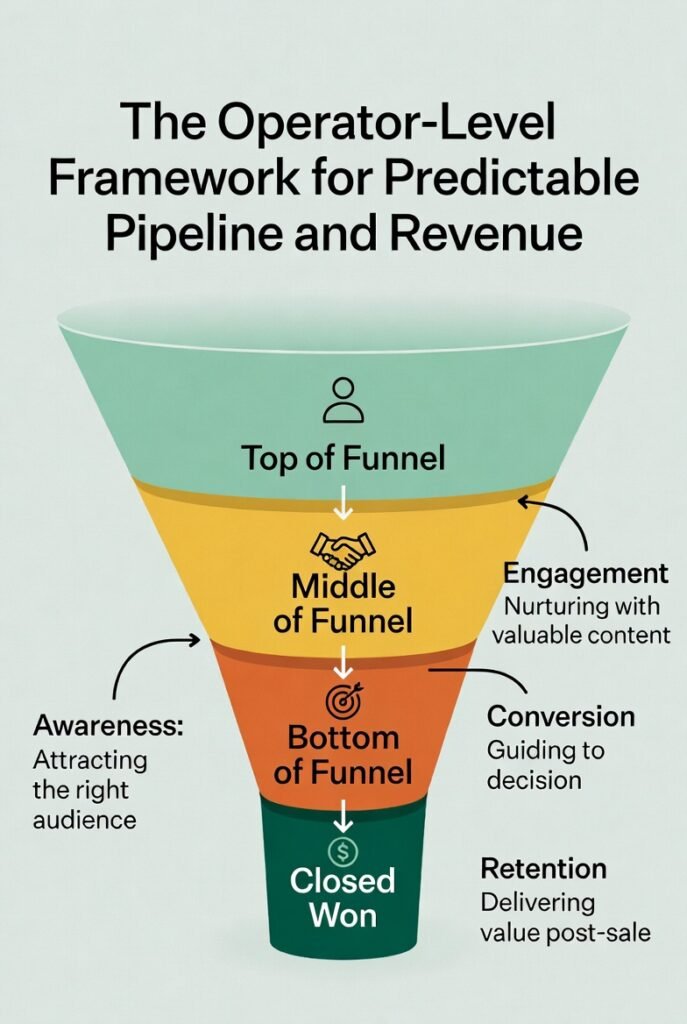
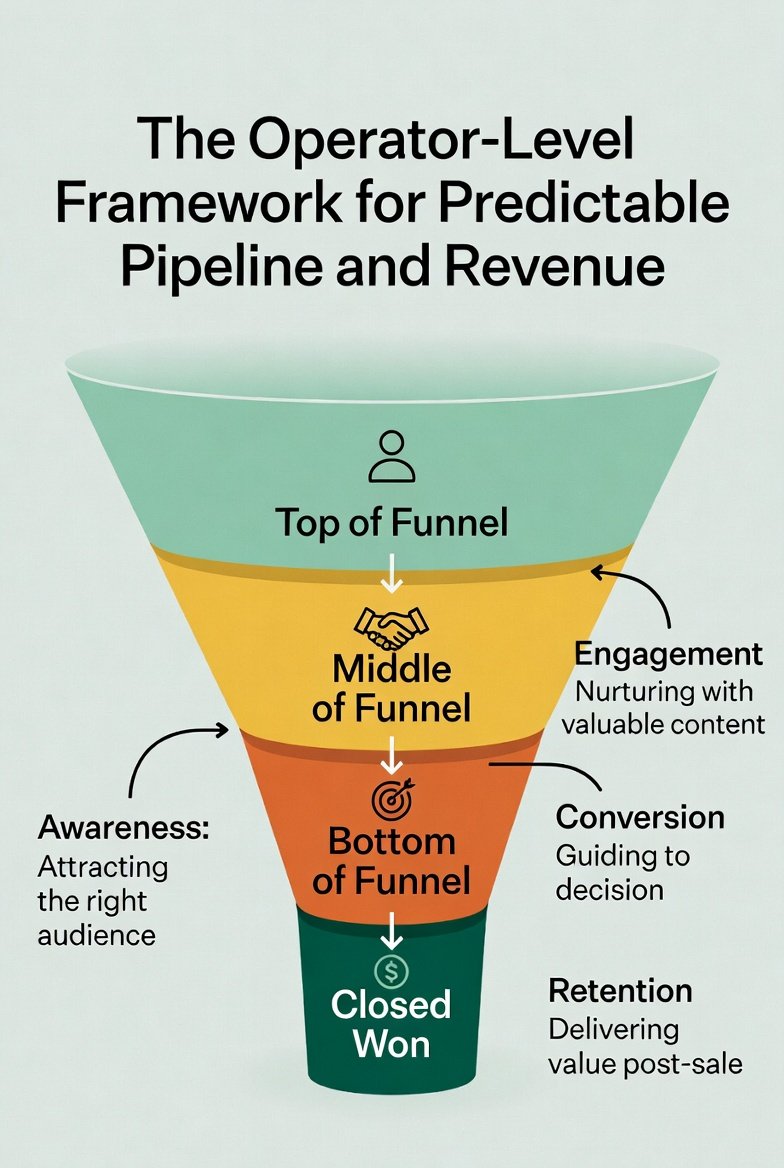
A marketing funnel is a structured progression that moves prospects through five psychological transitions:
- Unaware → Curious
- Curious → Evaluating
- Evaluating → Trusting
- Trusting → Buying
- Buying → Expanding
But modern buyer behavior has changed dramatically.
Funnels are no longer linear.
Stakeholders self-educate.
Buying committees form early.
Prospects revisit stages repeatedly.
High-performing organizations therefore design funnels that are:
✅ multi-entry
✅ automation-supported
✅ data-informed
✅ sales-aligned
Think less about the funnel “shape.”
Think about decision momentum.
Your job is not pushing buyers forward.
Your job is making forward movement feel safe.
Why Funnels Matter More Than Ever
Acquisition channels are fragmenting — search, AI discovery, communities, newsletters, private groups.
Attention is scattered.
Structure is now a competitive advantage.
Organizations that align funnel stages with sales processes often see conversion improvements exceeding 20–30% after workflow optimization — not because traffic increased, but because friction decreased.
Predictability scales companies.
Chaos stalls them.
This is why funnel design increasingly lives alongside marketing workflow architecture, not inside campaign planning alone.
Infrastructure beats tactics.
The Funnel Maturity Model (What Elite Organizations Build Toward)
One of the biggest gaps across the internet is the absence of funnel maturity context.
Not all funnels are equal.
Understanding where your organization sits changes what you should prioritize next.
Stage | Funnel State | Operational Reality |
Level 1 — Chaotic Funnel | Leads arrive randomly | No attribution, inconsistent pipeline |
Level 2 — Assisted Funnel | Sales drives momentum | Marketing supports but lacks control |
Level 3 — Automated Funnel | Systems guide buyers | Predictable conversion patterns emerge |
Level 4 — Predictive Funnel | Data forecasts revenue | Leadership plans growth confidently |
Most companies operate between Levels 1 and 2 — even when traffic looks healthy.
The leap from Assisted → Automated is where organizations begin integrating funnel logic directly into their marketing stack, ensuring systems reinforce buyer progression instead of relying on manual follow-ups.
Predictive funnels are where valuation multiples expand.
Investors trust predictable revenue.
What a High-Performing Funnel Actually Looks Like
Forget vanity metrics.
Elite funnels share observable traits:
- Consistent pipeline velocity
- Clear stage definitions
- Automated nurture paths
- Tight sales handoffs
- Measurable attribution
When these signals appear together, marketing stops being reactive.
It becomes operational.
In mature RevOps environments, funnel ownership often shifts toward revenue operations teams once automation depth exceeds basic nurture workflows — a structural evolution many fast-scaling companies now adopt.
Funnels mature into infrastructure.
The Real Economics of Funnel Design
Funnels are not just marketing tools.
They are financial levers.
A weak funnel quietly increases:
- Customer acquisition cost (CAC)
- Sales cycle length
- Lost opportunity cost
- Forecast volatility
A strong funnel does the opposite.
Even modest conversion improvements can reduce CAC dramatically because fewer prospects are required to generate the same revenue.
Pipeline speed is often a more reliable growth indicator than raw lead volume.
Operators measure velocity.
Amateurs measure clicks.

The Five Funnel Stages That Drive Revenue
1. Awareness — Filter, Don’t Chase
The biggest awareness mistake is optimizing for reach instead of relevance.
Effective top-funnel content pre-qualifies prospects before they ever speak to sales.
High-impact assets include:
- infrastructure guides
- operator frameworks
- technical explainers
- integration insights
If everyone enters your funnel…
no one feels understood.
2. Consideration — Authority Reduces Risk
Buyers aren’t just comparing products.
They are evaluating decision safety.
Your content should quietly answer executive concerns:
- Is this scalable?
- Will this age well?
- Are serious companies doing this?
This is where funnel strategy begins aligning tightly with marketing automation integrations, ensuring behavior triggers messaging that reflects buyer readiness rather than generic nurture sequences.
Context accelerates trust.
3. Evaluation — Where Funnels Quietly Break
Most funnels don’t fail at the top.
They fracture here.
Internal stakeholders appear.
Budgets get scrutinized.
Procurement slows momentum.
Evaluation-stage assets must remove organizational friction:
- ROI clarity
- implementation expectations
- governance compatibility
- migration transparency
When uncertainty drops, deals move.
Why Marketing Funnels Fail (And How to Detect It Early)
Nearly every SERP explains funnels.
Very few explain collapse signals.
Watch for these diagnostics:
🚩 Pipeline looks full but revenue lags
🚩 Deals stall late-stage
🚩 Sales requests “better leads”
🚩 Acquisition cost climbs
🚩 Forecast accuracy drops
Funnels rarely explode.
They leak.
Organizations that connect behavioral data with structured lead tracking detect these leaks faster — allowing teams to fix progression gaps before revenue is impacted.
Early diagnosis is a leadership advantage.
Common Structural Failures
Static funnel design — buyer behavior evolves; funnels must too.
Overloaded top-of-funnel — unqualified traffic overwhelms sales.
Mid-funnel neglect — uncertainty goes unanswered.
Disconnected systems — context disappears between tools.
Marketing-sales misalignment — momentum dies at handoff.
Funnels are living systems.
Treat them accordingly.
Inbound vs Ecommerce vs Physical Product Funnels
Not all funnels behave the same.
Inbound Funnels (B2B Heavy)
Long trust cycles.
Education-driven.
Multiple stakeholders.
Primary lever: authority.
Ecommerce Funnels
Speed dominates.
Buyers expect:
- product clarity
- frictionless checkout
- transparent shipping
- easy returns
Confidence drives conversion.
Physical Product Funnels
Often hybrid.
Buyers seek reassurance around durability, compatibility, and long-term value — making post-purchase communication a major driver of repeat revenue.
Structure must reflect psychology.
Funnel vs Flywheel — Which Model Wins Today?
You’ve likely heard the flywheel argument: retain customers, generate referrals, compound growth.
The reality?
This is not a rivalry.
Funnels create momentum.
Flywheels sustain it.
Without a funnel, you struggle to acquire.
Without a flywheel, you struggle to scale efficiently.
High-growth organizations build both — acquisition architecture feeding retention engines that stabilize expansion revenue.
Binary thinking limits growth.
Infrastructure thinking unlocks it.
When Does a Company Actually Need a Funnel?
Not every organization requires deep funnel engineering immediately.
But certain signals make the need unmistakable:
- inconsistent pipeline
- rising acquisition costs
- long deal cycles
- sales-marketing friction
- unpredictable forecasts
When leadership begins asking,
“Why can’t we predict next quarter?” —
you are already overdue.
Funnels restore executive visibility.
How to Create an Automated Sales Funnel (Operator Blueprint)
Avoid complexity early.
Clarity scales better than cleverness.
- Define the revenue event
Know exactly what conversion means. - Map buyer friction
Identify hesitation points. - Align messaging to objections
Every stage should neutralize one fear. - Automate progression triggers
Behavior should guide communication. - Measure stage leakage relentlessly
Velocity reveals health.
Organizations that formalize this structure inside marketing reporting frameworks gain something priceless:
Forecast confidence.
The Hidden Multiplier: Integration Depth
Disconnected tools create invisible drag.
Integrated systems improve:
- attribution accuracy
- personalization
- sales context
- executive reporting
Better data produces calmer buyers — and calmer buyers decide faster.
Limitations: Funnels Are Powerful — But Not Magic
Balanced operators acknowledge tradeoffs.
Funnels require:
- ongoing optimization
- technical stewardship
- content investment
- analytics discipline
Poorly maintained funnels create false confidence — dashboards look strong while conversion erodes underneath.
Infrastructure demands maintenance.
A Practical Reality Check
If your pipeline feels unpredictable…
…it usually isn’t the market.
It’s the path buyers are forced to navigate.
Strong funnels don’t pressure prospects.
They guide them — clearly, calmly, intentionally.
And once engineered correctly, they become one of the most durable growth assets an organization can own.
Final Takeaway
A marketing funnel is not about pushing prospects toward a purchase.
It is about engineering confidence at scale.
When friction drops, trust rises.
When trust rises, decisions accelerate.
That is how serious operators transform attention into predictable revenue — and why companies investing in funnel infrastructure today are quietly building tomorrow’s growth advantage.