

Salesforce Marketing Cloud Alternatives
Companies rarely wake up one morning and decide to replace Salesforce Marketing Cloud.
The decision builds slowly.
Costs climb.
Complexity spreads.
Campaign velocity drops.
Internal talent struggles to keep up.
Marketing automation Tools comparison
Executives start asking a dangerous question:
“Are we paying enterprise prices without getting enterprise leverage?”
Switching platforms is not a software decision.
It is an operational turning point.
Do it well — and execution accelerates.
Do it poorly — and you trigger one of the most painful migrations in modern marketing infrastructure.
This guide is written from the perspective most comparison pages ignore:
👉 Why serious companies leave Salesforce — and where smart operators go next.
First — When Should You Actually Leave Salesforce?
Before looking at alternatives, validate the trigger.
Leaving too early is reckless.
Leaving too late is expensive.
Legitimate Switching Signals
You may be outgrowing Salesforce Marketing Cloud if:
1. Operational Complexity Exceeds Team Capability
Salesforce is powerful — but power demands maturity.
If your team spends more time managing the platform than executing campaigns, leverage is inverted.
2. Total Cost Keeps Expanding
Licensing is only the visible portion.
Real enterprise cost includes:
- implementation partners
- developers
- admins
- integrations
- ongoing optimization
For many firms, the true annual cost quietly enters six figures.
3. Campaign Speed Is Slowing
Enterprise platforms should increase velocity — not create friction.
When launches require excessive coordination, the marketing stack is working against you.
4. You’re Not Using Half the Capability
One of the biggest hidden wastes in enterprise software:
Paying for theoretical power you never operationalize.
If your lifecycle sophistication doesn’t justify the infrastructure, downsizing is rational — not regressive.
The Migration Reality Most Articles Won’t Tell You
Switching automation platforms is closer to organizational surgery than software setup.
Expect friction across:
- data migration
- marketing workflow rebuilding
- retraining teams
- integration resets
- reporting adjustments
This is why smart operators do not chase tools.
They pursue operational alignment.
The Migration Decision Framework™
Evaluate alternatives through four lenses.
1. Complexity Fit
Choose a platform slightly ahead of your maturity — not five years beyond it.
Overbuying sophistication is the fastest route to shelfware.
2. Ecosystem Gravity
Does the platform integrate naturally with your:
- CRM
- analytics
- data layer
- campaign tools
Stack misalignment silently destroys attribution.
Leadership always notices — eventually.
3. Execution Velocity
Ask one simple question:
Will this platform help us move faster within 90 days?
If not, reconsider.
4. Migration Resistance
Some platforms are easier landing zones than others.
Minimize rebuild pain where possible.
Future you will be grateful.
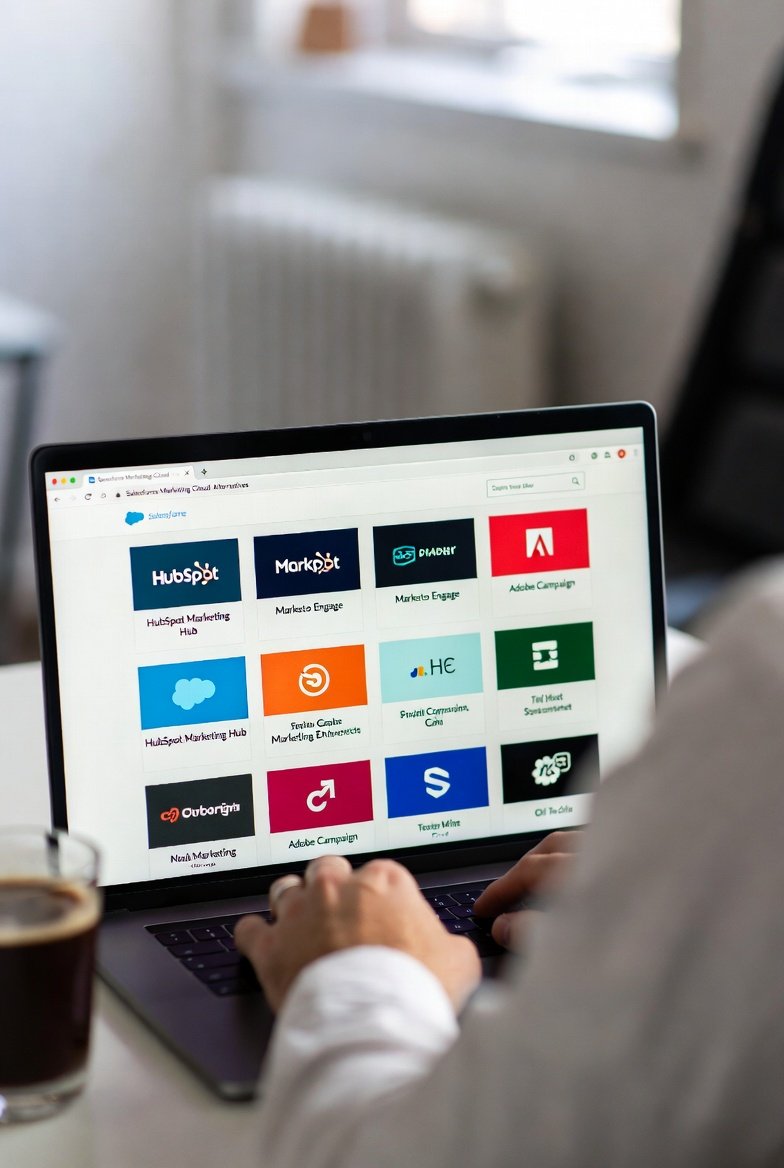
Best Salesforce Marketing Cloud Alternatives (Operator Comparison)
We shortlist serious contenders — not marketing noise.
HubSpot Marketing Hub — Best Strategic Downgrade Without Losing Power
Quick Verdict: The cleanest transition from enterprise heaviness → operational agility.
Why Companies Switch
- dramatically easier UI
- faster deployment
- strong automation
- native CRM setup alignment
- excellent reporting
Watchouts
- enterprise ceiling exists
- pricing rises with scale
👉 Ideal For: Mid-market firms wanting sophistication without Salesforce gravity.
Adobe Marketo — Best Enterprise Lateral Move
Quick Verdict: For companies that still need enterprise depth — just a different architecture.
Strengths
- elite segmentation
- powerful lifecycle automation
- strong analytics
- mature ecosystem
Tradeoffs
- implementation heavy
- requires operational discipline
👉 Ideal For: Organizations not reducing complexity — only replacing infrastructure.
Iterable — Best for Modern Lifecycle Marketing
Quick Verdict: Flexible, API-forward, built for adaptive teams.
Strengths
- cross-channel orchestration
- strong personalization
- scalable messaging
- developer-friendly
Tradeoffs
- requires technical maturity
- less plug-and-play
👉 Ideal For: Product-led or digitally mature companies.
Braze — Best for Real-Time Engagement
Quick Verdict: Exceptional for brands prioritizing immediate customer interaction.
Strengths
- real-time data flows
- excellent mobile engagement
- powerful segmentation
Tradeoffs
- pricing transparency varies
- setup complexity
👉 Ideal For: High-engagement B2C environments.
ActiveCampaign — Best Strategic Simplification
Quick Verdict: When enterprise tooling is unnecessary overhead.
Strengths
- advanced automation
- excellent value
- strong personalization
Tradeoffs
- not enterprise-grade
- reporting lighter
👉 Ideal For: Growth companies prioritizing speed over infrastructure weight.
Executive Comparison Table
Platform | Complexity | Best Fit | Migration Pain |
HubSpot | Medium | Scaling firms | Low–Medium |
Marketo | High | Enterprise | High |
Iterable | Medium–High | Digital-first orgs | Medium |
Braze | High | Engagement-heavy brands | Medium–High |
ActiveCampaign | Medium | Growth companies | Low |
Cost Reality — The Factor Driving Most Switches
Typical annual ranges:
Platform Tier | Estimated Investment |
Growth | $15K – $40K |
Mid-market | $40K – $120K |
Enterprise | $120K – $300K+ |
But remember:
The most expensive platform is the one your team cannot execute inside.
Adoption drives ROI — not capability.
The Point of No Return
There is a moment when leadership realizes:
- campaign velocity is declining
- marketing ops is overloaded
- cost justification is weakening
- lead tracking
At that moment, inertia becomes risk.
Companies that migrate proactively regain speed.
Those that delay often discover the cost through stagnation.
Implementation Blueprint (Steal This Before Switching)
Phase 1 — Architecture Audit
Document:
- workflows
- lifecycle stages
- integrations
- reporting logic
Never migrate blindly.
Phase 2 — Data Hygiene
Clean data BEFORE moving.
Bad data compounds during migration.
Phase 3 — Parallel Testing
Run limited campaigns before full cutover.
Reduce operational shock.
Phase 4 — Governance
Assign platform ownership immediately.
Or chaos returns.
Always.
Contrarian Insight Most Buyers Miss
Leaving Salesforce is rarely about technology.
It is about operational alignment.
The best alternative is not the most powerful platform.
It is the one that matches your organization’s ability to execute.
Potential Drawbacks (Balanced View)
Switching platforms introduces:
- temporary velocity loss
- training fatigue
- reporting recalibration
- stakeholder anxiety
But staying misaligned creates slower, more expensive damage.
Choose your friction.
Bottom Line
Salesforce Marketing Cloud remains one of the most powerful marketing platforms ever built.
But power without alignment creates drag.
When organizations choose an alternative that matches their operational maturity, campaign velocity returns, reporting stabilizes, and marketing regains its role as a predictable growth engine.
Migration is not retreat.
Done correctly — it is strategic realignment.
FAQs
Why do companies leave Salesforce Marketing Cloud?
Most leave due to cost expansion, operational complexity, slower campaign velocity, or underutilized enterprise capability.
What is the best alternative to Salesforce Marketing Cloud?
HubSpot offers the smoothest transition for mid-market firms, while Marketo remains the strongest enterprise alternative.
Is switching platforms risky?
Yes — but manageable with structured planning, data cleanup, and phased rollout.
How long does migration take?
Typically 3–9 months depending on organizational complexity.
Should smaller companies use Salesforce?
Often no. Enterprise infrastructure without enterprise maturity creates operational drag.