
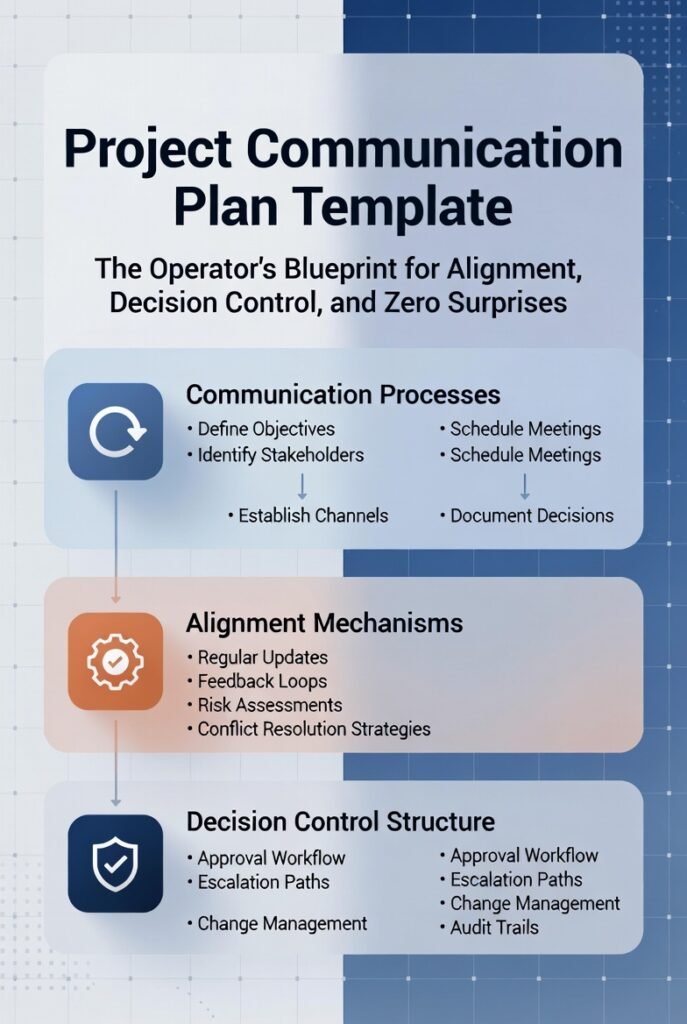
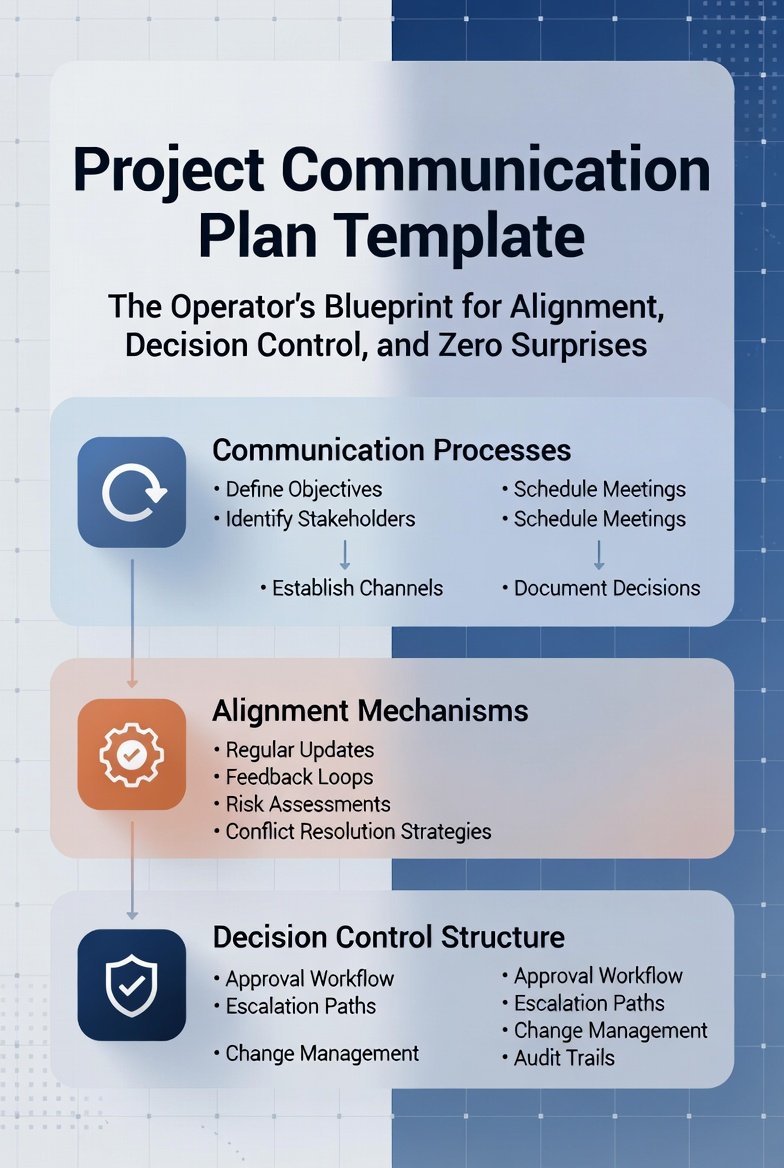
Project Communication Plan Template
Projects rarely fail because teams lack talent.
They fail because critical information reaches the wrong people — too late — in the wrong format.
A deadline slips and leadership hears about it days later.
Scope changes quietly but stakeholders assume the original plan still holds.
A risk surfaces, yet no escalation path exists.
By the time alignment is attempted…
Momentum is already gone.
A project communication plan is not administrative paperwork.
It is a governance system that protects execution speed.
Operators understand this.
Amateurs treat communication as updates.
Elite teams engineer it as infrastructure.
Executive Definition (Snippet Target)
A project communication plan template is a structured governance document that defines who communicates what, to whom, when, through which channels, and under whose authority — ensuring alignment, decision velocity, and operational clarity throughout a project lifecycle.
The executive question is simple:
👉 Will stakeholders ever be surprised?
If the answer is “possibly,” the plan is incomplete.
⭐ Copy-Paste Project Communication Plan Template (Primary Ranking Asset)
Use this as your one-page operating document.
Field | Operator Guidance |
Project Name | Define initiative clearly |
Executive Sponsor | Final authority |
Communication Owner | Usually project manager |
Stakeholder Groups | Segment by influence |
Communication Objectives | Inform, align, escalate, decide |
Channels | Email, dashboards, meetings, Slack, reports |
Cadence | Weekly, monthly, milestone-based |
Decision Authority | Who approves changes |
Escalation Path | Trigger → Owner → Timeline |
Documentation Hub | Single source of truth |
Success Metrics | Surprise rate, decision speed |
👉 Insert downloadable Doc / Google Sheets version here.
Why this wins:
Most templates list channels.
Operators define authority.
Why Projects Collapse Without Structured Communication
Misalignment compounds silently.
Then suddenly becomes expensive.
Communication Failure | Project Consequence |
Stakeholders uninformed | Late objections |
No decision clarity | Approval bottlenecks |
Hidden risks | Firefighting mode |
Channel chaos | Message distortion |
No documentation | “We never agreed on that” moments |
Here is the operator-level truth:
Communication is risk management disguised as coordination.
The Decision Velocity Principle
Communication tool is not about sending information.
It is about accelerating confident decisions.
Weak environments create:
- endless update loops
- meeting overload
- unclear ownership
- delayed approvals
Strong environments create:
Weak Model | Operator Model |
Update-heavy | Decision-focused |
Reactive | Predictive |
Informal | Governed |
Scattered channels | Structured flows |
Speed is born from clarity — not volume.
The Communication Governance Stack
Elite projects treat communication as infrastructure with five layers:
1. Stakeholder Segmentation
Not everyone needs identical visibility.
Segment by power and impact.
Stakeholder | Visibility Level |
Executive sponsor | High-level weekly |
Steering committee | Monthly + risk alerts |
Department leaders | Operational cadence |
Delivery teams | Real-time |
External partners | Milestone-driven |
Precision reduces noise.
2. Communication RACI (Rare but Powerful Asset)
Most templates skip this.
Operators never do.
Communication Type | Responsible | Accountable | Consulted | Informed |
Weekly status | PM | Sponsor | Team leads | Stakeholders |
Risk alert | PM | Exec | Legal/Finance | Steering |
Scope change | PM | Sponsor | Affected teams | Org |
Executive briefing | PMO | Sponsor | Leadership | Board |
👉 Collaboration ends where accountability begins.
3. Cadence Map (Authority Signal Table)
Cadence prevents leadership surprises.
Audience | Format | Frequency | Owner |
Executives | 5-bullet brief | Weekly | PM |
Steering | Deck | Monthly | PMO |
Teams | Standup | Daily/weekly | Leads |
External | Summary | Milestones | PM |
Consistency builds trust.
Surprises destroy it.
The Single Source of Truth (The Gap Most SERPs Miss)
Projects derail when multiple realities exist.
Choose ONE documentation hub:
- Notion
- Confluence
- SharePoint
- Smartsheet
Then enforce a rule:
👉 If it isn’t documented — it isn’t official.
This single discipline eliminates half of project friction.
🔥 Escalation Ladder (Elite Operator Artifact)
Most templates ignore this.
That is why projects stall.
Trigger | Escalate To | Response Time |
Timeline risk | Sponsor | <24 hrs |
Budget variance | Finance + Exec | 48 hrs |
Scope conflict | Steering | Immediate |
Regulatory concern | Legal | Same day |
Escalation is not failure.
It is content governance protecting momentum.

Decision Log Template (Screenshot-Worthy Asset)
Prevent the classic:
“We never agreed on that.”
Decision | Owner | Date | Stakeholders Consulted | Outcome |
Simple.
Powerful.
Often missing.
Crisis Communication — The Section Most Plans Forget
Projects are stable…
Until they aren’t.
Define messaging BEFORE turbulence.
Prepare templates for:
- delays
- outages
- vendor failures
- security incidents
- regulatory risks
Calm communication preserves confidence.
Silence breeds speculation.
Metrics That Reveal Communication Health
Measure alignment — not email volume.
Metric | What It Signals |
Stakeholder surprise rate | Alignment quality |
Decision turnaround time | Authority clarity |
Update compliance | Operational discipline |
Rework caused by misalignment | Communication strength |
What leaders measure becomes behavior.
Why Over-Communication Is Dangerous (Contrarian Insight)
More communication is not always better.
Over-communication causes:
- signal fatigue
- ignored updates
- meeting saturation
- slower execution
The goal is not maximum communication.
It is precision communication.
AI — The Emerging Communication Multiplier
AI is beginning to support projects through:
- automated summaries
- action extraction
- sentiment detection
- risk flagging
But operators verify outputs.
Because speed without judgment creates misinformation at scale.
Technology amplifies systems — good or bad.
The Project Communication Maturity Curve
Level | Organizational State |
Level 1 | Ad hoc updates |
Level 2 | Basic schedules |
Level 3 | Structured plans |
Level 4 | Governed communication |
Level 5 | Predictive alignment |
Most organizations plateau at Level 2.
Elite operators live at Level 4+.
The Point of No Return
There is a moment when informal communication collapses.
Usually triggered by:
- enterprise initiatives
- cross-functional complexity
- regulatory exposure
- transformation programs
When this happens…
Governance is no longer optional.
It becomes survival infrastructure.
Potential Drawbacks (Balanced Perspective)
Strong communication systems introduce:
- upfront planning
- documentation discipline
- leadership involvement
- Management program
But unmanaged misalignment is exponentially more expensive than structured clarity.
The objective is not friction elimination.
It is controlled execution speed.
What Operator-Level Communication Actually Looks Like
Inside mature project environments:
- stakeholders know when they will hear updates
- authority is visible
- escalation is predictable
- decisions accelerate
- trust compounds
This is not bureaucracy.
It is execution architecture.
Final Executive Takeaway
A project communication plan is not a template.
It is a control system.
Without it:
- surprises multiply
- decisions stall
- politics expand
With it:
- alignment stabilizes
- execution accelerates
- leadership maintains control
Clarity is never accidental.
It is engineered.